A spine tattoo for women is designed in height. The piece follows the line of the back, from the base of the neck down to the small of the back, within a band that stays narrow. Image searches for this area mostly show fine, ornamental pieces: a mandala or a lotus extended with beads, a flowering stem that climbs upwards, a phrase in cursive, moon phases, a dagger or a snake. Here are 24 black-line ideas, sorted by motif, followed by our placement tips. You will also find our temporary spine tattoos, so you can try a design on your skin before choosing. If you are still torn between several areas of the back, our women's back tattoo page goes through them all.
Mandala, lotus and tassels: the ornament that runs down the spine


This is the classic spine composition: a focal point at the top or in the centre, then a line that runs down and grows finer.
A central motif, then a fall. The first idea places the petals of an open lotus between the shoulder blades. Below it, a chain of beads and dots thins out into a droplet. The dotwork mandala works the other way round: it sits in the middle of the back, with ever smaller beads leading away from it upwards and downwards. The third piece, in lace, looks like a candelabrum: symmetrical scrolls, hanging droplets and no solid black at all.
Two other designs play on repetition. The three mandalas of decreasing size, joined by dots, read like a descent. The line of beads punctuated with droplet tassels recalls a back jewel, the kind you wear with an open-backed dress.
These pieces work on the spine because they are symmetrical around an axis. When you bend over, the skin stretches lengthways, but the axis stays straight. Keep the centre of the mandala or lotus exactly on the line of the vertebrae: on a design this symmetrical, the slightest shift is noticeable.
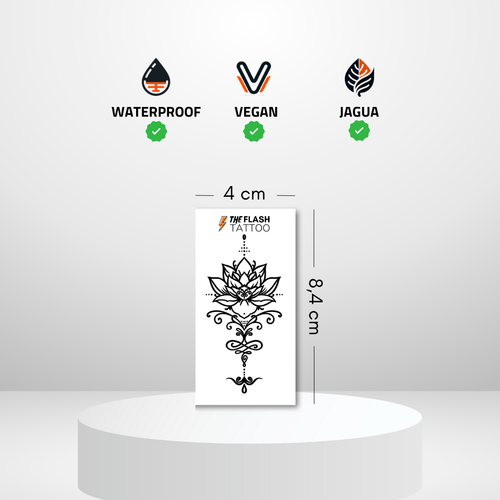
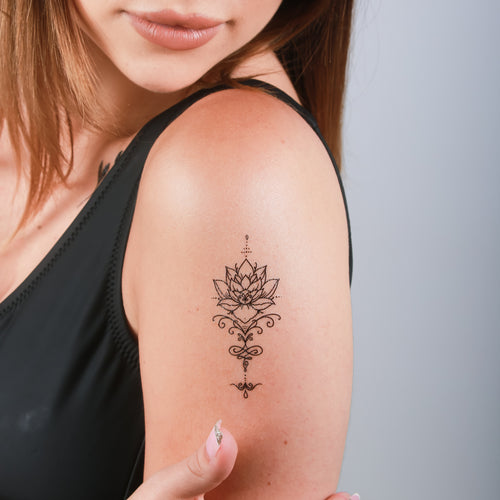
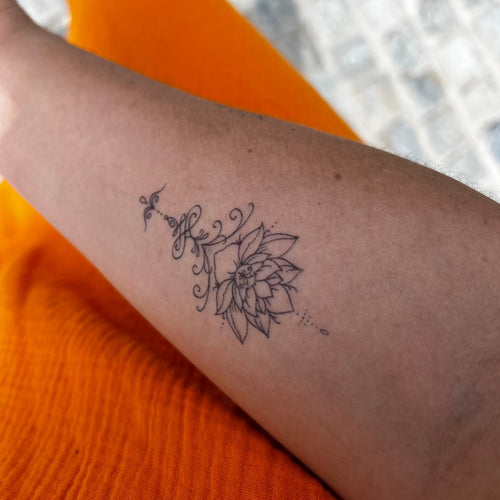
The designs on this page are ideas, not products. To try a vertical piece on your skin, these designs from our collection are available right now:





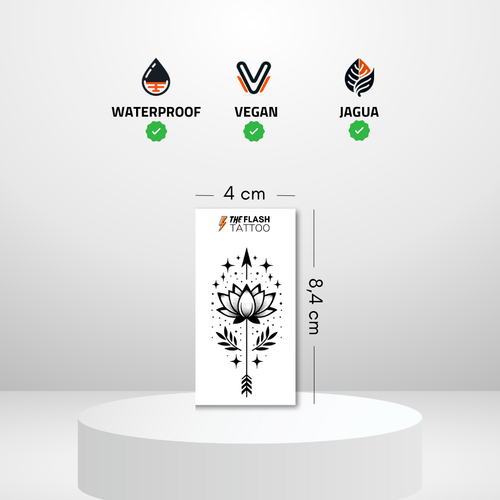
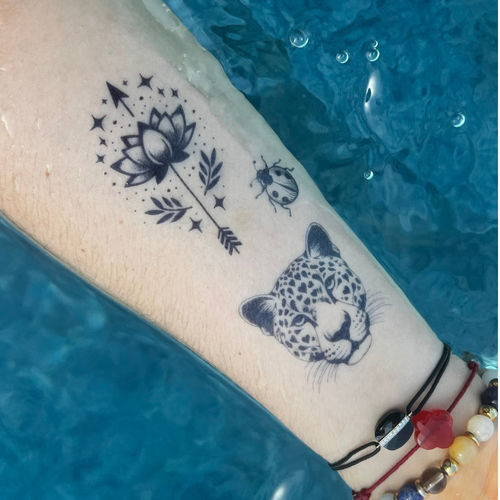
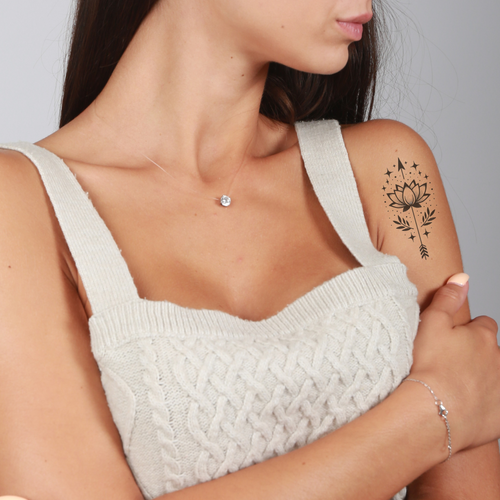


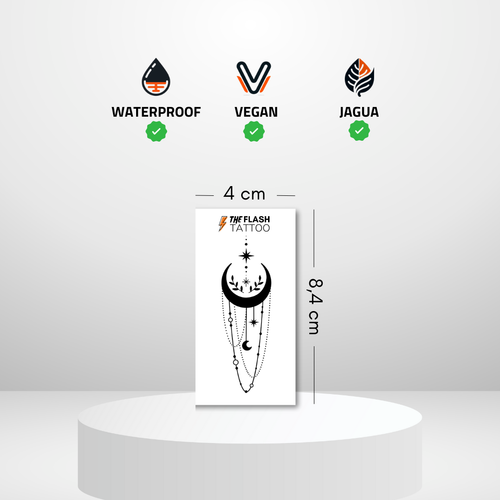


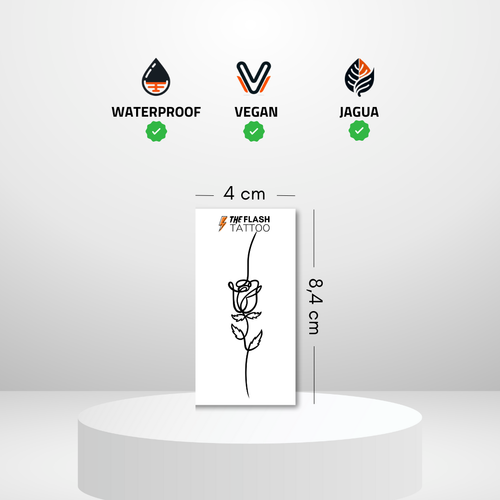


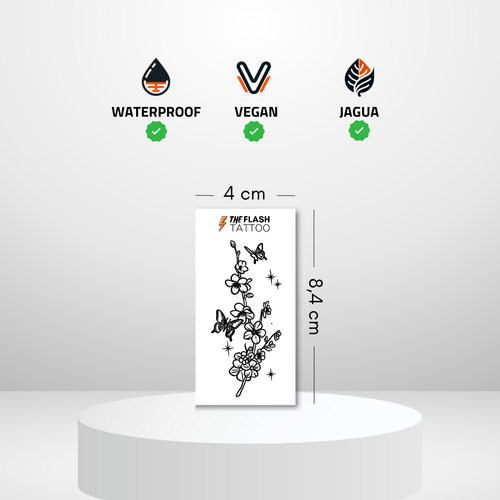


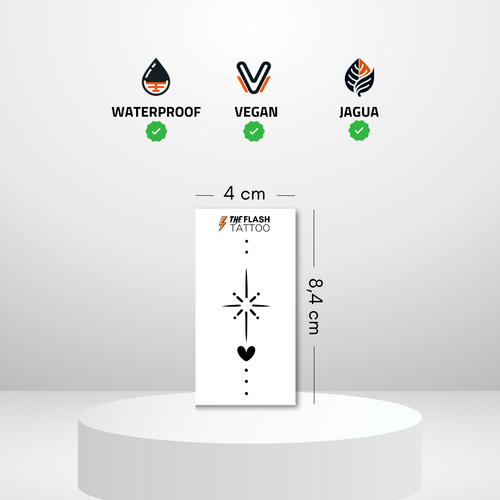
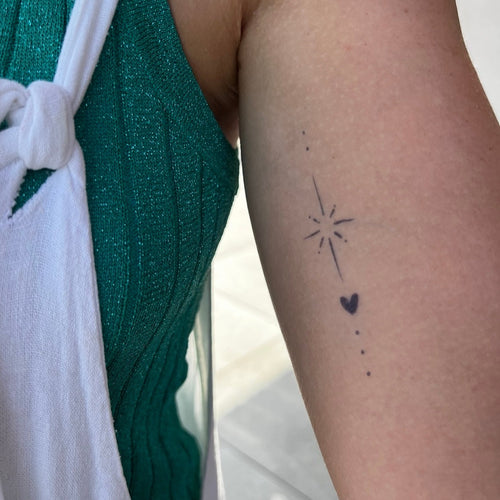

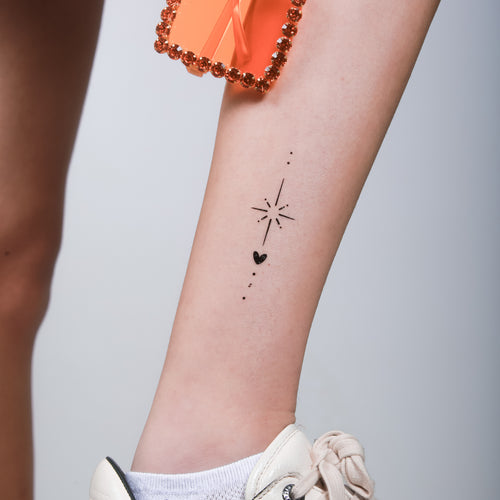


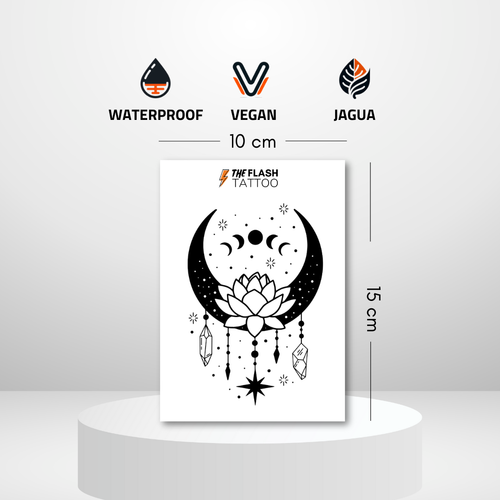
Flowers climbing up the spine


Flowers are the other big family for the spine. Here, what matters most is not the flower but the stem: long, straight or slightly curved, it is what gives the design its direction.
The rosebud tops an almost straight thorny stem, with two leaves as its only width. It climbs up from the base of the spine. The wisteria cluster goes the opposite way: it starts at the top and cascades down, with blossoms getting smaller towards the tip. The cherry blossom branch traces a gentle S, for anyone who wants a little movement without leaving the axis. The lily of the valley lines up its bells on one side of the stem. The slender lily, with its two open flowers and a bud, takes up more room at the top and suits the middle of the back.
One tip applies to all of them: few leaves, well placed. An overloaded stem widens the band and strays from the axis. As a temporary tattoo, our elongated 8.5 × 4 cm format, placed vertically, is enough for a whole rose or sprig of lily of the valley.
More floral ideas can be found on the women's flower tattoo page.
Phrases and vertical lettering


Phrases feature in searches for this area, and it makes sense: a vertical word follows the spine effortlessly. One question remains to be settled before drawing. Will the word be read by tilting your head, or from top to bottom, letter by letter?
“Respire” (“breathe”), in fine cursive, illustrates the first solution: the word is turned a quarter turn, and the joined letters unfold in a single stroke. “AMOR FATI”, in Roman capitals, follows the same logic and reads like an engraved inscription. The date “XII · VII · MMXIX”, that is 12 July 2019 in Roman numerals, illustrates the second: each number gets its own line, from the day at the top to the year at the bottom. Replace it with your own date, and have the conversion checked: a mistake in Roman numerals easily goes unnoticed.
For lettering, keep it short: 1 to 3 words. Beyond that, the letters become too small to stay legible on such a narrow band. Check the spelling twice, and have any phrase written in a language other than your own checked by someone who speaks it.
Moon, planets and aligned symbols


The spine lends itself to sequences: several elements placed one under the other, telling something in order.
The moon phases on this page place the full moon in the centre, in dotwork. The crescents thin out towards both ends, so the design is denser in the middle of the back and lighter at the top and bottom. The aligned planets vary in size, Saturn and its ring included, and are joined by a line so fine you can barely make it out. The column of symbols links a sun, a crescent, an eight-pointed star, an eye and a small diamond, each at an equal distance from the next. Finally, the hanging moon carries droplets and stars suspended beneath it, like an earring.
In a sequence like this, the spacing makes the design. Regular gaps give a calm piece, and gaps that tighten give the impression of a fall. Count the elements too: the more there are, the longer the piece needs to be for each to keep its place.
Dagger, arrow and snake: bold lines


These three motifs are vertical by nature: you don't need to stretch them to make them fit the spine.
The ornamental dagger points downwards, with an ornate guard and a solid black diamond in the hilt. Two small droplets fall from the blade. Its solid black areas give it weight, which makes it legible from a distance. The boho arrow, pointing upwards, carries a fletching of feathers and a few beads threaded on the shaft. Softer in feel, it sits happily between the shoulder blades. The snake undulates in an S along its whole length, its head raised towards a small crescent moon, its scales made of dots.
For these three motifs, orientation changes how the design reads. With the point or head upwards, the design seems to climb towards the nape. Pointing down, it seems to descend towards the small of the back. If you are unsure, have someone photograph your back with the motif placed one way, then the other, and compare the two images.
Discreet, delicate spine tattoos


Discreet, small, minimalist: these words come up again and again in image searches for the spine. The area has an advantage here: a collar or just about any top is enough to hide the motif, and a backless top reveals it.
The small crescent on a line of five dots fits in our smallest format, 3 × 3 cm, and sits just below the nape. The fine feather, placed vertically, makes better use of the elongated 8.5 × 4 cm format. The ear of wheat, with its grains drawn one by one, stays light despite its detail, because its line is fine. The ribbon bow, whose two tails run down along the vertebrae, is all about delicacy: it sits at the top of the back, where an open-backed dress lets it show.
To keep a small motif legible, keep the detail to a minimum. At 3 cm, two lines that are too close end up merging. A clean outline and two or three elements are better than a full design shrunk to the extreme.
More ideas on our women's minimalist tattoo page.
Fine line, dotwork, lace, solid black: which style to choose
Once you have chosen the motif, there is still the style. Four styles work well on the spine, and each has its example in the gallery.
- Fine line: a thin, even line, almost without shading. This is the style of the lily of the valley and the ribbon bow. It suits discreet pieces and lettering.
- Dotwork: the shading is made of dots, packed more tightly where the area needs to look dark. The central mandala and the aligned planets use it: the piece keeps its depth without becoming heavy.
- Ornamental, or lace: scrolls, droplets, beads and strict symmetry. The lace candelabrum is the textbook example.
- Solid blackwork: filled areas of black. The dagger's hilt has some, and that is what makes it legible from a distance.
These four styles do without grey. That is also the rule for our temporary tattoos: no grey and no gradients, shading is done with dots or solid areas. The designs in this gallery are conceived the same way.
Where to place it on the spine, and how long it lasts
The spine is not a uniform area. It starts below the nape, passes between the shoulder blades and ends in the small of the back, and each part has its own constraints. The choice of motif depends on them as much as on your taste.
The same approach exists, area by area, for all tattoo placements.
The top of the spine, below the nape
The top of the spine suits small motifs and the start of long pieces: the crescent and its dots, the ribbon bow, the petals of a lotus. Hair tied up shows it off, and hair worn down covers it. To line up the design, find the bump that sticks out when you lower your head: that is your starting point.
💡 Did you know?
This bump has a name: the vertebra prominens. It is generally described as the 7th cervical vertebra, the C7. Yet a study of 39 subjects found the C7 to be the most prominent in only 48.7% of cases, against 35.9% for the C6.
So trust the bump you can feel, not its number. Here, the bone sits close to the surface: the area is reputed to be sensitive to the needle. As a temporary tattoo, if the motif climbs all the way up to the nape, allow 3 to 5 days for this part, because of necklaces and clothing collars.
Between the shoulder blades
This is the heart of the spine, framed by the two shoulder blades, with a little more room at the sides. The boho arrow, the central mandala or the lily all find their place here. A bra or a strappy top often crosses this area: place the motif above or below the band rather than level with it, otherwise it rubs all day. The vertebrae stay close to the skin, hence the area's reputation for being sensitive to the needle. It is still the back: as a temporary tattoo, allow 5 to 10 days of wear, depending on how you look after it.
To shift the motif to the side, see the women's shoulder blade tattoo page.
The bottom of the spine, in the small of the back
Lower down, the spine sinks into the small of the back. The skin there is fleshier, and the area is reputed to be less sensitive than the top. This is where long pieces end, with the lotus droplet or the tip of the dagger, and where climbing stems begin, like the rose's. Watch out for belts and waistbands: as a temporary tattoo, this friction wears the motif away faster. The range stays that of the back, 5 to 10 days depending on how you look after it.
For a horizontal motif here, see the women's lower back tattoo page.
The full length
A piece that runs from the nape to the small of the back makes the biggest impact, but it is also the trickiest to centre. It has to stay on the axis whether you are standing tall or bending over. Our largest formats go up to 15 × 10 cm: they don't cover the whole spine. To judge the overall effect, line up two or three motifs one under the other, for example a mandala at the top followed by a line of beads. Then look at the result in a photo, from behind, before deciding.
The same questions arise on a man's back, with different proportions: see the men's spine tattoo page.
What these motifs mean on the spine
The meaning lies in the motif, not in the spine itself. Here are the readings often given to the designs on this page. They are pointers, not rules: everyone can give them a completely different personal meaning.
- The lotus opens above the water. It is often read as rebirth, or the idea of growing despite difficulties.
- The mandala, built around a centre, is often associated with balance and harmony. Placed on the spine, it literally marks the centre of the body.
- The moon and its phases evoke cycles and change. Lined up from top to bottom, they read as the passing of time.
- The snake, which sheds its skin, is often chosen as a symbol of transformation and renewal.
- The dagger is commonly associated with protection and courage.
- The arrow speaks of moving forward and keeping a course, especially when its point rises.
- The feather evokes lightness and freedom.
- “Amor fati”, Latin for “love of fate”, is a way of saying you accept whatever comes.
First choose what the design says to you, then check that it finds its place on the spine. Wearing it for a few days as a temporary tattoo will quickly tell you whether it still speaks to you once it is on your skin.
To compare other motifs, across all areas, take a look at our gallery of tattoo ideas, sorted by motif.
Try the design as a temporary tattoo before you decide
The 24 designs on this page are for inspiration. To know whether a vertical piece suits you, the most telling thing is to see it on your own spine. Our temporary tattoos use jagua ink, from an Amazonian fruit. The ink is vegan, PPD-free, and is applied without a needle and without pain. The design darkens and develops over 24 to 48 hours, then turns black or deep blue depending on your skin's pH. Our temporary tattoos last up to 2 weeks depending on the area and how you look after it. On the spine, which counts as the back, allow 5 to 10 days. The design is water-resistant from 24 hours after application. For the first 8 hours, just avoid any rubbing.
Use these days to check what a screen can't show you: the length, the alignment when you bend over, the effect under a backless top. Get someone to help you apply it, since you can't see your own spine. The step-by-step is explained in how to apply your temporary tattoo. When the time comes, removal is done by exfoliation: see removing a temporary tattoo.
Our catalogue has over 500 designs. Here are some more, different from the first ones, available right now:
 Cherry blossoms
 Awakening snake
 Magic feather
 Swallow's breath
 Dragonfly tattoo
 Mandala
 Captured dreams
 Black dagger
Frequently asked questions
Does it hurt on the spine?
With a needle, the spine is reputed to be sensitive, because the vertebrae sit just beneath the skin, especially at the top and between the shoulder blades. The lower part, in the small of the back, is fleshier and has the reputation of being more bearable. The sensation varies from person to person. A temporary tattoo, on the other hand, doesn't hurt: it is applied without a needle, and you can judge the design without feeling a thing.
How long does a temporary tattoo last on the spine?
On the spine, as on the rest of the back, allow 5 to 10 days, depending on how you look after it. If the motif climbs onto the nape, that part lasts 3 to 5 days. Our temporary tattoos last up to 2 weeks depending on the area. What wears them down is friction: chair backs, straps, belts. Avoid them for the first 8 hours. Here are all our tips for making a temporary tattoo last longer.
Which style ages best on the spine?
There is no rule that holds for every skin: ask your tattoo artist, who will assess the design and the area. One criterion remains reliable, legibility. A design with well-spaced lines and no tiny details stays clear from a distance. Fine line, dotwork, ornamental and solid black each have their example in the gallery: compare them on your skin as temporary tattoos before choosing.
Can you hide it at work?
Yes, easily. Just about any top covers the spine, except a backless top or a dress that is open at the back. Only the top of the motif may peek out, if it climbs towards the nape and your hair is tied up: a collar or hair worn down is then enough to cover it. If you want a motif you only show when you choose to, have it start below the collar line.